
In industrial environments where precision and reliability are essential, an efficient control system is crucial for optimising HVAC operations. Advanced control solutions play a central role in ensuring optimal performance, sustainability, and safety, from maintaining stable production conditions to reducing energy consumption. In applications such as pharmaceuticals, food processing and electronics, even slight temperature, humidity or ventilation fluctuations can compromise product quality or regulatory compliance. This is why precise environmental control is not just a technical requirement, but also a strategic advantage. When properly managed, modern HVAC systems can intelligently adapt to real-time demand. This minimises energy waste and contributes to broader carbon reduction goals. At the same time, advanced control platforms enable continuous monitoring of environmental parameters helping to reduce operational costs.
Explore Daikin’s wide-ranging solutions for industrial applications, a product portfolio designed to meet every challenge with innovation and efficiency. Click here to discover more.
HVAC control systems and industrial processes: overview of needs
Industrial processes often require high-capacity heating or cooling, sometimes simultaneously and across multiple zones with different temperature requirements. This complexity demands HVAC systems that are powerful, flexible and intelligent. The ability to manage groups of units, each of which may operate under different conditions, is essential to ensure that every part of the process receives the exact thermal input it requires. Moreover, reliability is non-negotiable. Failure in temperature control can halt production, damage materials or endanger safety. This is why industrial HVAC systems are designed with redundancy, robust components and advanced monitoring to ensure continuous operation.
In response to the growing demand for high-temperature applications, Daikin has introduced a new feature to its water source heat pump VZ series, enabling hot water production at up to +90 °C. This significant enhancement, made possible by using the low-GWP refrigerant R-1234ze, means the unit is suitable for a wider range of uses, including industrial settings where high water temperatures are essential.
Discover the power of high-temperature heat pumps: download our white paper on the Daikin VZ Series. Click here to learn more.
The Daikin control system for industrial applications
When it comes to HVAC control, industrial applications pose unique challenges. These applications require precise temperature regulation, high-capacity performance and the ability to manage multiple units operating under different thermal conditions, all while ensuring efficiency, reliability and cost-effectiveness. Daikin’s Intelligent Chiller Manager (iCM) is a cutting-edge control solution designed specifically for challenging industrial settings.
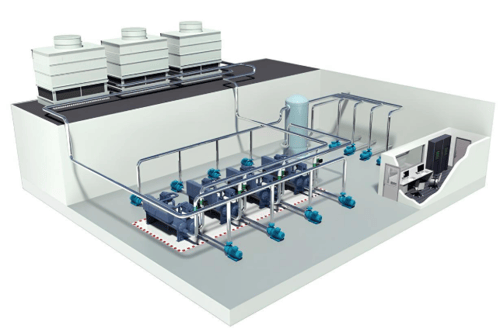
To optimise the operation of chiller groups within a plant, the iCM coordinates the operation of each unit with the others, ensuring that performance goals are achieved with minimal energy consumption and mechanical effort. Seamlessly integrating with Daikin’s cloud-based monitoring platform, Daikin on Site (DoS), the iCM© is also compatible with the most widely used building management systems (BMS), ensuring smooth and comprehensive building integration. At the heart of its functionality lies the ability to manage the sequencing and staging of chillers, heat pumps and multipurpose units, dynamically adapting to the operational needs of the plant. Powered by the Microtech 4 controller, the iCM is flexible and comprehensive control solution, supporting mixed plant configurations in both heating and cooling modes and incorporates a wide range of features that go beyond basic unit control. These include:
- Heat recovery management
- Free cooling management
- Energy and performance monitoring
- Rapid restart
The iCM can manage up to eight units, coordinating the operation of each unit within the system, enabling each chiller to efficiently reach its performance targets, thereby reducing energy consumption and mechanical stress. The result is a system that improves overall durability and efficiency while significantly lowering operating and maintenance costs.
The iCM can decide which units to activate, when, and how, maximizing energy efficiency while extending the overall lifespan of the system. Available as an optional extra for make-to-order units, Daikin’s iCM represents a significant advance in intelligent HVAC control, tailored to meet the evolving demands of modern industry.
For more information, feel free to contact us.
The system control strategy of chillers and heat pumps in industrial facilities
The iCM system can automatically activate units to ensure temperature stability, energy efficiency, and system reliability. This is made possible by sequencing and staging functions, which adapt dynamically to the operational needs of the system.
In particular, the sequencing function continuously evaluates which units should be activated or deactivated, selecting the next one based on criteria such as balancing machine wear or following a predefined operational sequence.
To further enhance reliability, one unit can be designated as a standby unit. This unit remains inactive but is ready to take over in the event of an alarm or when all active units are operating at full capacity and the system setpoint has not yet been reached.
The staging function controls the activation and deactivation of units based on the system’s water temperature to balance the thermal load. It optimises the number of units in operation to maintain system efficiency in both two-pipe and four-pipe configurations, enhancing overall unit performance.
By combining sequencing and staging, the iCM system ensures optimal performance and thermal comfort while extending the lifespan of equipment through balanced and intelligent unit management.
Daikin Digital Controls for air handling units in industrial settings
The Daikin Digital Control Platform is a reliable and scalable control solution specifically designed for Professional Series air handling units for industrial applications. This highly flexible platform enables the efficient and integrated management of all unit sections.
Based on a decentralised architecture, each air handling unit (AHU) section is equipped with a digital control box that connects local sensors and actuators. All signals are then managed by a central DDC controller, ensuring precise, modular control of the entire system.
This control solution offers a wide range of benefits, making it an ideal solution for modern modular systems. Its exceptional flexibility enables the connection of up to 310 inputs and outputs, surpassing the limitations of traditional setups by a large margin and allowing for the seamless integration of a greater number of modules. The system's compact design is further enhanced by streamlined wiring, most of which is pre-installed at the factory. This reduces clutter and eliminates the need for extra space, as the wiring is integrated within the unit sections.
Standardisation plays a key role in ensuring consistent quality. The entire solution is factory-integrated and pre-wired, guaranteeing uniform performance and significantly cutting installation time. Ultimately, these efficiencies translate into lower overall costs, making the Professional Series more competitive in the market.
Daikin’s solutions for Industrial applications
Daikin offers dedicated solutions designed to meet the specific needs of industrial applications. In today's landscape, it is essential to adopt advanced strategies and technologies that optimise performance and extend the operational life of systems. Daikin's innovations, such as cooling system optimisation, provide cutting-edge solutions that reduce operating costs and minimise environmental impact, making installations more efficient, reliable, and sustainable.
Daikin can provide a comprehensive range of advanced HVAC solutions tailored to meet specific demands. Recognizing that systems operate under partial loads for over 95% of the time, it integrates Variable Frequency Drives (VFDs) to help save energy, reduce wear on equipment, and improve system performance. Daikin also integrates its proprietary technologies, such as Variable Volume Ratio (VVR), into its single screw compressors to ensure optimal efficiency and adaptability to any changing conditions. To further enhance energy performance, Daikin chillers can be equipped with integrated active harmonic filters (AHFs), which reduce power distortions and improve overall system efficiency. These components are refrigerant-cooled and housed within the unit for maximum reliability.
Download the white paper on Daikin’s Integrated Active Harmonic Filter and discover how to enhance power quality in your HVAC systems.
Daikin provides a wide portfolio of air-to-water and water-to-water heat pumps for heating needs, offering capacities from 10 to 2400 kW and hot water temperatures up to +90°C.
Explore here the in-depth product article.
Download the full papers to discover more about Daikin’s HVAC system optimisation solutions:
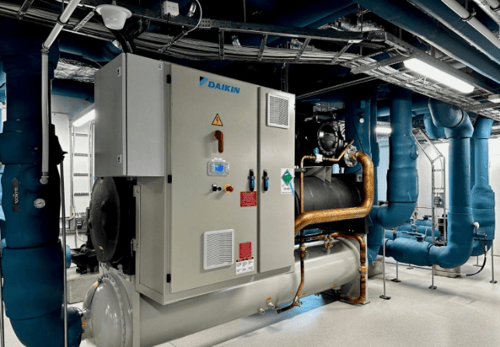
When it comes to indoor air quality, Daikin provides high-performance air handling solutions designed to meet the strictest reliability, efficiency, and environmental control standards. These systems are particularly well-suited to sensitive environments and industrial applications where precise air management is essential. Daikin’s Professional Air Handling Units (AHUs) are equipped with high-efficiency HEPA filters capable of achieving H14 filtration levels following EN 1822. This ensures exceptional air purity, making them ideal for environments where even the smallest airborne particles must be controlled. Humidity regulation is another critical aspect of indoor climate control. Daikin addresses this need by integrating both adiabatic and isothermal (steam-based) humidification systems into its AHUs. These technologies enable precise, adaptable humidity management tailored to each application's specific requirements. To guarantee a continuous and efficient operation, Daikin’s AHUs are equipped with electronically commutated (EC) fans. These fans improve energy efficiency and enhance system reliability, ensuring consistent performance under varying load conditions.
To learn more, download our dedicated white paper on Daikin’s air handling technologies for industrial facilities.
For more information, please contact us.