
Data centers are the backbone of the digital economy, supporting essential services such as cloud computing, streaming, industrial applications, and financial services. The growth of Artificial Intelligence (AI) is increasing rack densities and computing requirements, creating new challenges in terms of performance, reliability, and energy efficiency. In this context, cooling systems play a critical role in ensuring operational continuity while containing energy consumption. To manage increasingly demanding thermal loads, liquid cooling is emerging as a scalable and efficient solution for the data centers of the future.
What Cooling Technologies Are Available for Data Centers?
For many years, air cooling was the standard approach to data center thermal management. Today, however, the rapid increase in rack power density, driven primarily by AI workloads, is making it increasingly difficult to dissipate heat efficiently using air alone. As a result, liquid cooling technologies are becoming more prominent thanks to their superior heat transfer capabilities. Among the most widely adopted solutions are direct-to-chip cooling, which cools CPUs and GPUs directly through cold plates, and immersion cooling, where servers are submerged in dielectric fluids. While multiple technologies are expected to coexist, direct-to-chip cooling is currently considered by many industry stakeholders to be the most practical and scalable approach for supporting the high power densities required by next-generation AI infrastructure. This trend is also highlighted in the State of European Data Centers 2026 report by EUDCA, which identifies direct-to-chip liquid cooling as the leading driver of innovation in cooling technologies. Indeed, 64% of respondents consider it a realistically deployable solution within their organization over the next two years, compared to 24% who view immersion cooling as a viable option.
Why Choose a Liquid Cooling System?
One of the main reasons for adopting liquid cooling is its ability to improve data center energy efficiency. One of the most widely used metrics for measuring efficiency is Power Usage Effectiveness (PUE). PUE is calculated by dividing the facility's total energy consumption by the energy consumed by IT equipment. The lower the PUE value, the less energy is required to support IT operations, resulting in significant reductions in operating costs. In the United Kingdom, energy efficiency has become a strategic priority for data center operators, driven by rising energy costs, the UK’s Net Zero Strategy, and increasingly stringent sustainability expectations from both regulators and customers. In addition, data center operators are being encouraged to improve energy performance and reduce carbon emissions in line with broader national decarbonisation objectives and international sustainability frameworks. Cooling systems represent one of the largest sources of energy consumption within a data center. According to the International Energy Agency (IEA), cooling and environmental control can account for approximately 7% of energy consumption in the most efficient hyperscale data centers and more than 30% in less efficient enterprise facilities. Other industry studies estimate that cooling may represent as much as 40% of a facility's total energy use. In traditional air-cooled architectures, large volumes of air must be continuously moved, conditioned, and distributed to remove heat generated by IT equipment. As rack power densities continue to rise, driven by the rapid growth of Artificial Intelligence (AI), High-Performance Computing (HPC), and advanced cloud workloads, the energy required by fans, air handling units, and chillers also increases. This makes it increasingly challenging to achieve the high levels of efficiency expected in modern data center environments. In this context, liquid cooling is emerging as a strategic technology for supporting the next generation of high-density data centers. By capturing and removing heat directly at the source, close to processors and accelerators, liquid cooling significantly reduces the energy required for thermal management, helping operators achieve lower PUE values while reducing long-term operating expenses. Another advantage that is particularly relevant in the UK market is the potential for heat reuse. The higher water temperatures typically associated with liquid cooling systems can facilitate the recovery and repurposing of waste heat for district heating networks, commercial buildings, and industrial processes. This aligns with the UK's wider sustainability goals and growing focus on improving overall energy efficiency across the built environment. In addition, liquid cooling enables significantly higher rack densities than those achievable with conventional air cooling. This capability is becoming increasingly important as AI clusters, HPC installations, and next-generation server platforms continue to grow in scale and power requirements. For designers, consultants, and operators developing future-ready digital infrastructure, liquid cooling is no longer an emerging technology. It is rapidly becoming an essential solution for delivering the efficiency, scalability, resilience, and sustainability required by modern high-performance data centers.
What Is the Role of a CDU in a Liquid Cooling System?
To understand the role of a Coolant Distribution Unit (CDU), it is useful to examine the architecture of a liquid cooling system.
Most direct-to-chip installations are based on two separate hydraulic circuits:
Facility Water System (FWS)
The Facility Water System connects the data hall to the central cooling plant. Its primary function is to transport the heat generated by the IT infrastructure to chillers, dry coolers, or other heat rejection systems.
Technology Cooling System (TCS)
The Technology Cooling System directly serves the IT racks. This circuit distributes coolant to the cold plates installed on processors and accelerators and returns the heated fluid to the cooling system before recirculation.
The separation of these two circuits provides significant operational and safety benefits. The facility side and the IT side can operate with different flow rates, pressures, water quality requirements, and temperature ranges, improving both flexibility and overall system protection.
The Role of the CDU
The CDU serves as the critical interface between the FWS and TCS circuits. Its primary functions include:
- Heat exchange between the two circuits.
- Hydraulic separation.
- Flow management.
- Pressure control.
- Temperature regulation.
- Cooling system monitoring and protection.
By continuously regulating operating conditions, the CDU ensures that sensitive IT equipment receives coolant within the parameters specified by server manufacturers.
With the growing adoption of liquid cooling, CDU performance and reliability are becoming increasingly important considerations in cooling infrastructure design.
To address these evolving requirements, Daikin introduces its new range of Coolant Distribution Units, available from November 1, 2026, following their official preview at the Cannes industry event.
Learn more about the innovations unveiled by Daikin at Datacloud 2026 in Cannes and contact our team to discover how the new unit can support your data center requirements.
CDU Selection Criteria and the Benefits of the Daikin CDU
The new Daikin CDU has been designed to meet the high-availability requirements typical of mission-critical digital infrastructure. The system architecture incorporates numerous features aimed at increasing operational resilience, including redundant pumps, duplicated pressure and temperature sensors, an integrated leak detection system, advanced alarm management, and options dedicated to power continuity.
The choice of materials also reflects this reliability-focused approach. The hydraulic circuit is constructed entirely from AISI 316L stainless steel and utilizes grooved mechanical couplings throughout the system, eliminating the need for welding. This solution enhances corrosion resistance while simplifying installation and maintenance activities throughout the lifecycle of the cooling infrastructure.
Space efficiency is another key priority for data center operators. Every square meter occupied by cooling infrastructure reduces the space available for IT equipment. For this reason, the Daikin CDU offers capacities of up to 2.5 MW per unit, enabling support for high-density environments while minimizing the footprint in technical areas and maximizing the floor space available for IT racks.
Explore the Daikin CDU range and identify the solution that best meets the requirements of your project.
Another key differentiator is configuration flexibility. The range is available in multiple sizes, with capacity increments of approximately 200 kW up to 2.5 MW, allowing designers and consultants to accurately size the system according to current and future requirements. This modular approach also facilitates the gradual expansion of cooling capacity, supporting infrastructure growth without complex interventions.
The CDU also incorporates advanced monitoring and control capabilities, including redundant sensors and precise regulation through a two-way valve configuration. This ensures stable operating conditions and consistent cooling performance, even under highly variable IT loads.
How to Choose the Right CDU Supplier?
According to the Uptime Institute Data Center Staffing and Recruitment Survey 2025, supply chain challenges continue to be among the main concerns for data center operators. Forty-two percent of respondents reported issues related to supplier lead times, while 17% experienced quality-related problems in delivered equipment. In this context, selecting the right CDU cannot be separated from choosing a reliable partner capable of providing technical expertise, manufacturing capacity, and support throughout every stage of the project lifecycle. Working with a supplier that has proven experience in data center cooling helps reduce project risks while supporting schedule compliance and operational objectives. Daikin combines decades of HVAC engineering expertise with deep specialization in mission-critical cooling applications, delivering a comprehensive data center cooling ecosystem. Thanks to robust manufacturing capabilities, a structured supply chain, and extensive experience in managing large-scale and complex projects, Daikin is well positioned to support customers even in the most demanding scenarios. Its expertise in mission-critical applications, combined with advanced production capabilities and a reliable supply chain, enables the successful execution of projects of virtually any scale and complexity. Furthermore, with a complete portfolio that includes chillers, air-based cooling solutions, liquid cooling infrastructure, and control systems, Daikin can support customers with integrated and optimized solutions tailored to every data center cooling requirement. The availability of skid-mounted solutions, featuring multiple CDUs integrated and configured for parallel operation, represents an additional benefit for data center projects. This approach simplifies installation and commissioning activities while reducing on-site integration requirements. The use of standardized and prefabricated configurations also streamlines procurement and project coordination, helping reduce site complexity, accelerate deployment schedules, and improve overall project predictability.
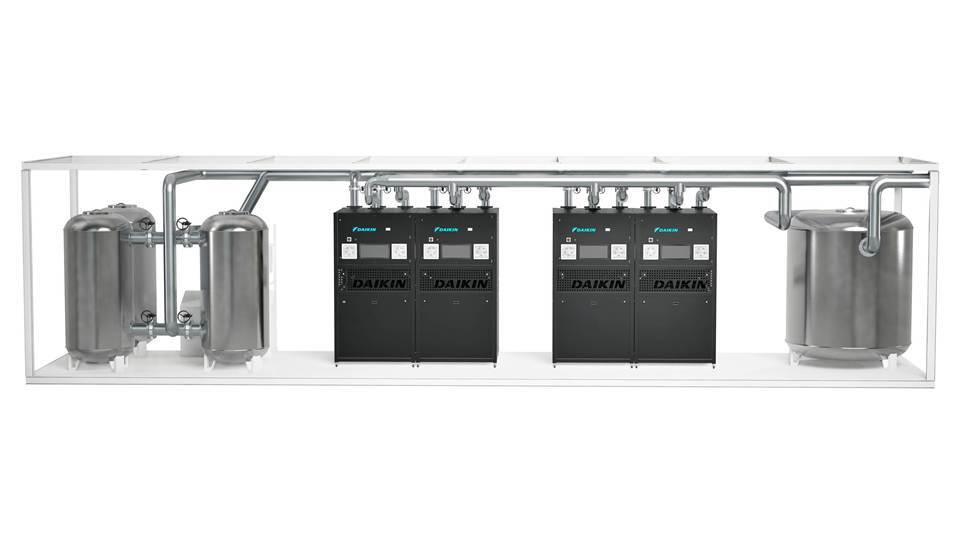
Choosing the right CDU is essential to ensuring efficiency and reliability. Choosing the right partner is what enables those results to be achieved over the long term.
Visit the dedicated Daikin Data Center Solutions section.